If the lack of affordable housing in your community is keeping you up at night, you’re in good company (subtext: for once, your sleep routine isn’t to blame). According to the International Economic Development Council’s (IEDC) State of the Field 2025 survey:
- 56.6% of organizations are actively addressing affordable and workforce housing priorities.
- 51.1% are seeking new partnerships around affordable housing and residential development.
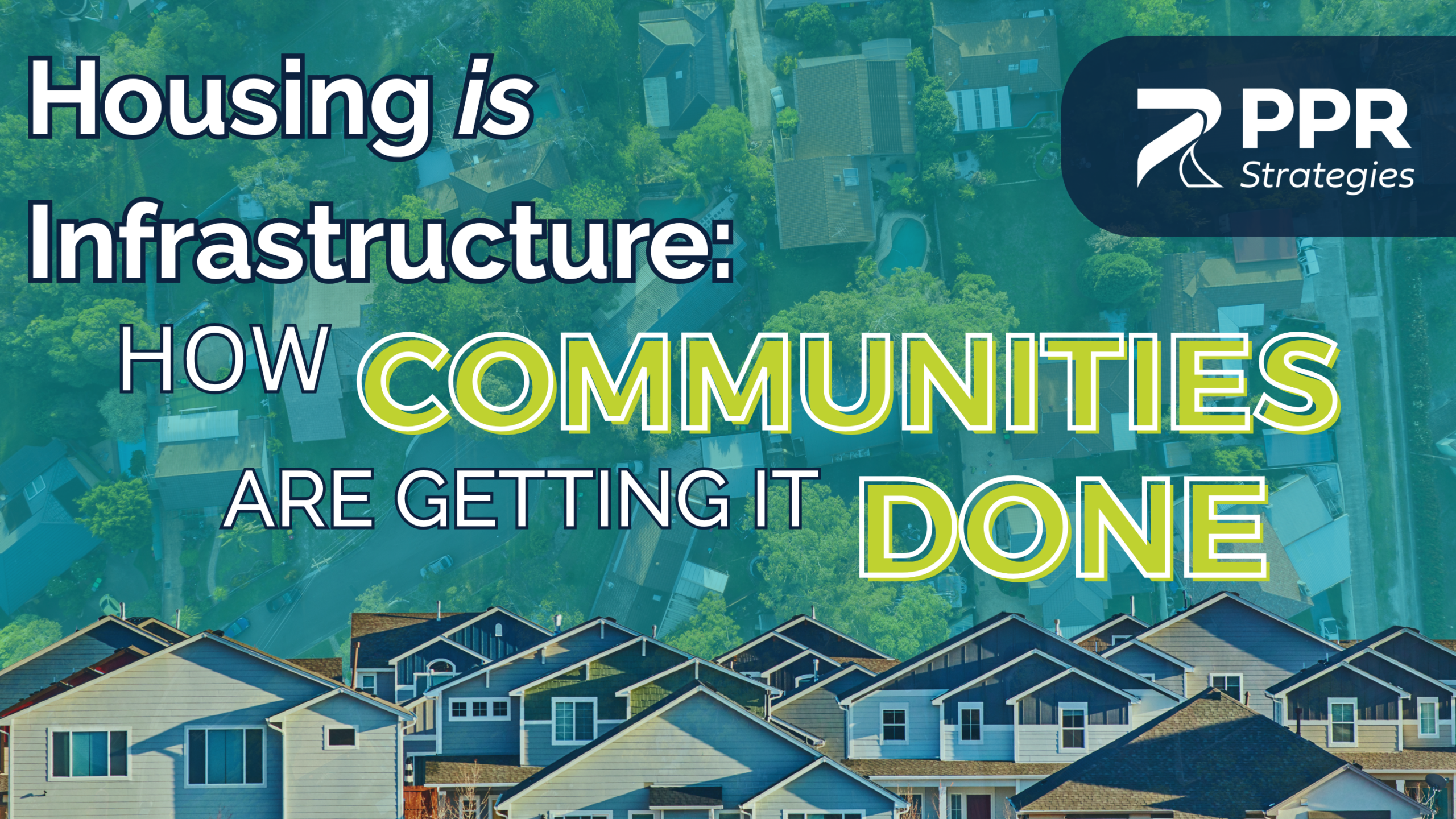
When teachers, first responders, and talented professionals powering the workforce pipeline cannot afford to live in our communities, we’ve reached a tipping point. The solution? A collaborative approach that treats affordable housing not as a social service, but as infrastructure, which is as vital to a thriving community as roads, utilities, and broadband.
How are our peers tackling these challenges? Read on.
Bentonville, Arkansas: Public-Private Incentives That Build Equity
In Bentonville, the city’s CORE Housing Program is blending discounted workforce homes alongside market-rate properties through smart public-private incentives. In one development featuring single-family cottages and multi-family units, the local school district and healthcare industry joined forces to remove barriers to traditional homeownership, reserving units for teachers and hospital staff and offering equity-building programs to help workers eventually purchase permanent homes. Residents can build up to $50,000 in equity over a five-year lease, which can then be applied as a down payment on a future home. By weaving key partners into a regional ecosystem, Bentonville is proving that when the right people sit at the table, the community wins.
Silver Spring, Maryland: A $2 Land Deal with Impact
In Silver Spring, nonprofits are a key element of the solution. Montgomery County, Affordable Homes and Communities (AHC), and Habitat for Humanity recently joined forces to create a $95 million, 195-home development, and it started with a land contribution that cost just $2. Montgomery County transferred a former administrative office site to Habitat for Humanity and AHC at that nominal price, eliminating the majority of upfront land costs and unlocking the entire project. Today, the development serves families earning between 30% and 70% of the area median income (AMI), with more than half of the rental units accessible at 30% to 50% AMI, roughly $44,000 to $82,000 for a family of four. Habitat for Humanity’s homeownership model sweetens the deal further, offering zero-interest mortgages and capping housing costs at 30% of a buyer’s income. Sometimes the most powerful deals start with the smallest price tag.
Seattle, Washington: Turning Brownfields into Community Cornerstones
Seattle’s collaborative dynamos transformed a formerly contaminated, vacant industrial site into a vibrant mixed-use community near a light rail station. By splitting the site, the project simultaneously delivers market-rate housing and subsidized workforce and low-income housing. Private developers Thrive Communities and Lake Union Partners took on the financial risk of environmental remediation, tackling a polluted brownfield that traditional developers had long avoided, while nonprofit co-developer Mount Baker Housing Association ensured that more than 300 units would be permanently dedicated to individuals and families earning 30% to 60% AMI. The City of Seattle and Washington State Department of Ecology provided gap funding and streamlined the cleanup process. The result is a textbook example of what’s possible when every sector shows up.
Alexandria, Virginia: Affordable Housing as a Community Wellness Strategy
Alexandria is taking a multigenerational approach to affordable housing by connecting residents to essential community amenities. Once complete, the renovation of the 57-year-old Ladrey Senior High Rise will enhance livability for more than 300 residents, while the redevelopment of the Samuel Madden community will serve as a model mixed-use development for working families. Upon completion, Samuel Madden will feature new apartments, 13,300-square-feet of retail space, a 500-square-foot fresh food hub, and a 13,500-square-foot early learning center anchored by the historic nonprofit Hopkins House. Together, these projects reflect Alexandria’s vision of affordable housing as foundational infrastructure, integrating housing, childcare, and nutrition under one united framework.
We’re Better Together
Housing is essential infrastructure, plain and simple. Bringing together partners from across sectors to share best practices, learn from each other’s experiences, and have honest conversations about the barriers and opportunities in their communities is a proven way forward. When the public, private, and nonprofit sectors work together, they create powerful frameworks to accelerate the pace of change.
Is there a collaborative approach that’s moving the needle in your community, or one that’s stalling despite best efforts? I want to hear about it; drop me a line!