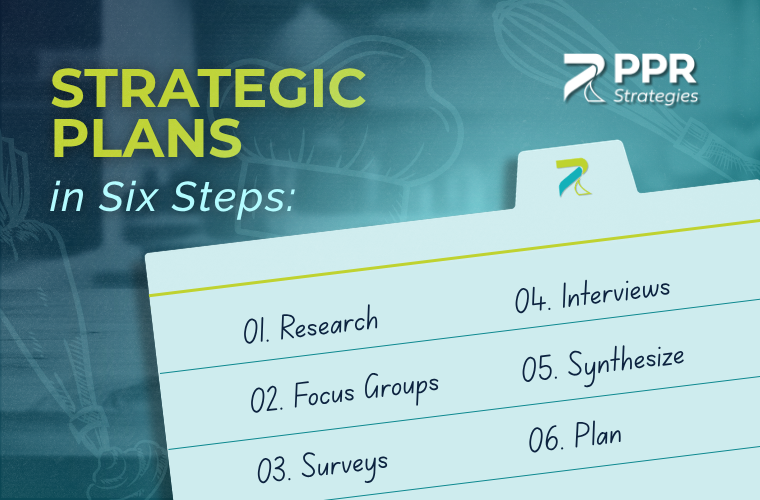
Every strategic plan we build starts the same way a good recipe does: with a process you can trust. Skip a step or wing it because you think you know better, and things fall flat (or set off your fire alarm). Over the years, we’ve refined our approach into six clear steps that take an organization from “we have a lot of ideas” to “we have a plan we’ll actually use.” No shortcuts, no guesswork, just deep experience and a process we know (and trust). Here’s how it comes together.
- We Snoop Around First (Politely)
Every strategic plan starts with us getting nosy, but we are polite about it. Before we ask anyone a single question, we conduct an ambitious archaeological dig on an organization’s history, current initiatives, opportunities, and challenges. Honestly, it’s our way of reading the room before we start talking. This research foundation means we’re asking better questions later, and building the plan on facts, not vibes.
- We Get the Whole Room Talking
Next, we round up the right people: board members, staff, community partners, and whoever needs a seat at the table, for focus groups. Group conversations are great for surfacing shared priorities, but let’s be honest: not everyone loves talking in a room full of people.
Here’s an example: someone says, “Sure, a blue car works for me!” when what they actually mean is, “I really wanted the red car, but everyone else said blue, so blue it is.” Even well-intentioned groups can nudge people toward consensus over candor. Middle school habits die hard!
So we’re intentional about making space for quieter voices too, not just the loudest ones in the circle.
- We Give the Quiet Ones a Microphone
Stakeholder surveys are safe spaces where many participants shine. Surveys let people tell us what they really think without the pressure of an audience. No performing, no polite answers, no wondering if the boss is listening. Some of our richest insights come from these anonymous, unhurried responses: the ones that rarely surface in a group setting.
- We Sit Down One-on-One
Here’s where the magic really happens. One-on-one interviews, often with board members, leaders, and key stakeholders, create a level of trust and honesty that’s hard to replicate anywhere else. These conversations are where people feel truly heard, and where we frequently uncover the themes that end up anchoring the entire plan.
- We Turn All That Talking Into a Plan
Once we’ve gathered feedback from research, focus groups, surveys, and interviews, it’s time to make sense of it all. We roll up our sleeves, dig into the data, spot recurring themes, prioritize opportunities, and sort the “fix it now” operational stuff from the “build toward this” strategic goals. Ultimately, this is the framework that becomes the strategic plan.
- We Dream Big, Then We Get Real
We love a client with big dreams where the sky’s the limit. But a strategic plan only works if it’s grounded in reality: available resources, staff capacity, and what can actually get done in the life of the plan. We’re also seeing more organizations lean toward shorter, more flexible one-, two-, or three-year plans to stay nimble in a fast-changing world. Even so, we always keep an eye on the horizon, 10-15 years out, because where you want to end up should shape the choices you make today.
Why It Works
A strategic plan isn’t meant to be a paperweight (or sit on my bookshelf of cookbooks). It’s meant to be used as a compass for decision-making, a way to stay focused on what matters most, and a framework for measuring progress along the way.
Our goal at PPR Strategies isn’t just to write a strategic plan. It’s to build a process that’s iterative, thoughtful, and sometimes uncomfortable along the way. In the end, it helps organizations listen, align, prioritize, and move forward with confidence.
Ready to get your strategic plan started? Drop me a line!