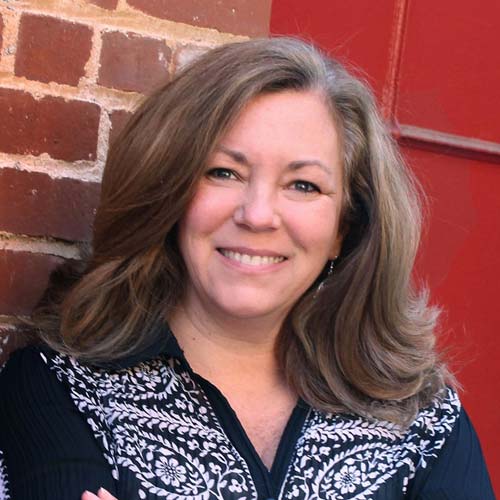
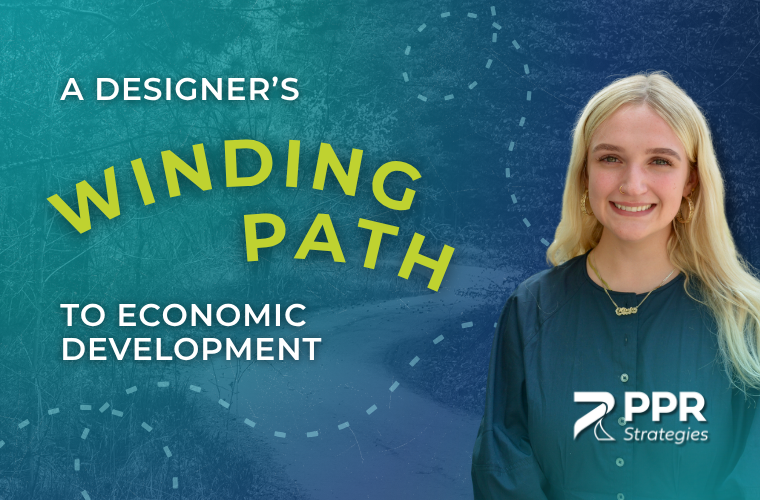
This blog was guest-written by our Digital Storyteller, Olivia Asam. Take it away, Olivia!
I’m a few months removed from design school, a few months into my first full-time design job, and somehow writing a blog for a company full of professional communicators. So, you’re probably wondering: How did I get here?
I’ve happily described myself as a creative for as long as I can remember. Like many artists, I still recall that first tricked-out art supply set gifted by a loved one and the excitement that came with it. But while creativity was always part of who I was, I didn’t always know what that would mean for my career. Much of my family has a background in hospitality and tourism, including my parents, who own the Bavarian Inn in Shepherdstown, West Virginia. Growing up around the Inn, hospitality and tourism were part of my everyday life and the professional world I knew best.
By the time I reached high school, I was taking more advanced art classes and starting to think seriously about college and what might come next. I knew in my heart that I wanted to pursue a creative career, but I wasn’t quite sure what that could realistically look like or how it would fit alongside the hospitality world I had grown up around.
Ultimately, I followed my intuition and earned a degree in graphic design from the Savannah College of Art and Design. What drew me to graphic design was that it gave my creativity a purpose. I could make something visually interesting while also solving a problem or helping someone understand something in a new way.
What I didn’t realize at the time was that graphic design might also become an unexpected intersection between my creative interests and my background in hospitality and tourism.
Destination: Economic Development
That winding path eventually led me to PPR Strategies as the company’s first in-house graphic designer, where I’ve had the opportunity to bring those different parts of my background together.
Coming into my first few weeks at PPR, economic development was new territory for me. But having previously worked in my family’s hotel and restaurant, the tourism industry was familiar, and it provided a natural segue into this world. Now, I get to interact with an industry I’ve known for much of my life from an entirely different perspective, with a much greater understanding of how tourism fits into the bigger picture of a community.
Every day, it feels rewarding to design for real-world clients and communities, making an impact in our corner of the world. I’ve found myself working with people and places whose work I’ve benefited from throughout my own life, often without even realizing it.
And that’s beginning to change the way I think about what it means to be a graphic designer.
So far, I’ve had the opportunity to create work that plays a small part in telling the stories of these communities. I’ve designed everything from annual reports to advertisements, maps, and logos, and I’m learning that each piece has a purpose beyond simply looking good.
Seeing something I’ve created actually put to use has been one of the most rewarding parts of the transition from design school to the working world. There is something exciting about knowing the work has a life beyond the project itself and knowing communities can be understood through something I’ve created.
Visual Communication for Communities
Design school taught me early on that graphic design is about much more than making things look pretty. My professors often pointed out that some schools call their graphic design programs “visual communication,” which, honestly, might be the better-fitting title. Now that I’m in the working world, I’m beginning to understand why.
As PPR’s Digital Storyteller, that’s exactly what I get to do. A lot of my job is taking something that needs to be communicated and figuring out how to tell that story visually. Since entering the world of economic development, I’ve realized just how important that can be. Communities have stories to tell, but they also have opportunities and resources that people need to know about. Good design can help make those things easier to see and understand.
That bigger picture is something I didn’t fully have in design school. I’m still relying on the same foundation I built there, but I’m thinking much more intentionally about the purpose behind what I create and who I’m creating it for. It’s given the skills I spent years developing a new sense of context.
As our business ramps up for the fall, I imagine that my winding path will take me down Main Streets, coastal communities, and bustling cities, all of which have important stories to tell. If the past few months are any indication, I still have plenty to learn, and I’m excited to see where it takes me.
—
Thank you, Olivia, for sharing your story; we’re lucky to have your creativity and fresh perspective on the team!
If Olivia’s piece left you wondering how strong visual storytelling could help tell your own community’s story, I’m all ears, so drop me a line!