Ask an economic developer, Main Street manager, tourism professional, or community leader what makes their community special, and you’ll likely hear about transformative projects, major employers, thriving small businesses, downtown revitalization efforts, parks, schools, or quality-of-life amenities.
And they’re right. These investments are essential. They create opportunity, strengthen local economies, improve quality of life, and help communities compete for businesses, residents, and visitors.
If you keep the conversation going, something interesting often happens: the discussion shifts from projects to people.
Someone shares a story about the annual carnival that’s become a family tradition. A farmers market that feels more like a weekly reunion. A beloved local restaurant where everyone knows each other.
Suddenly, you’re no longer talking about what a community has. You’re talking about who a community is.
At PPR Strategies, we believe a community’s story is told through both its progress and its people. Major investments demonstrate where a community is headed, while local traditions reveal what makes it worth calling home. Together, they’re the stories that help people picture themselves living there, opening a business there, or returning year after year.
One example comes from my neighborhood in Adamstown, Maryland.
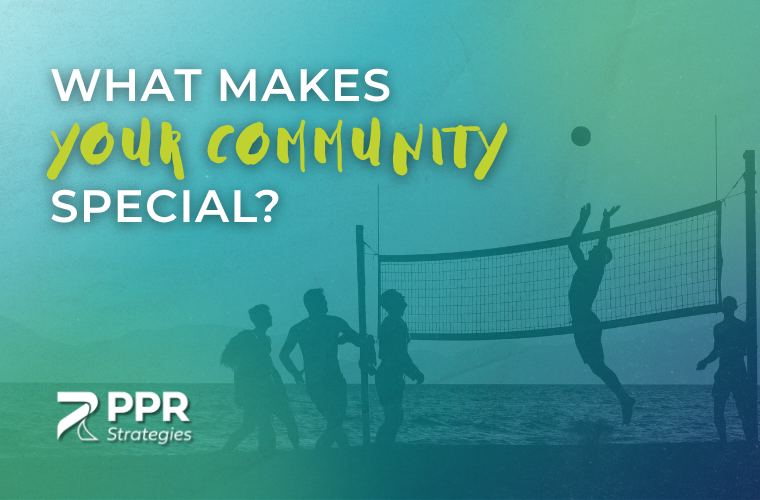
In 2004, a Green Hill Manor resident started a neighborhood volleyball league with a simple goal: to give neighbors a reason to socialize, spend time outdoors, and stay active together.
More than two decades later, that simple idea has grown into an iconic summer tradition. Each Wednesday evening from the end of May through July, teams gather on neighborhood home courts across Green Hill Manor. The season culminates in an all-day tournament where all 15 teams compete for the coveted Golden Ball Trophy before spending the evening celebrating together.
I’ve had the unique opportunity to experience the league from nearly every perspective. I grew up watching Wednesday night games from the sidelines until I was old enough to join at 18, eventually playing alongside my family and close family friends.
The league also sparked my own love for volleyball. Watching from the sidelines led me to play throughout middle school, high school, and college. Today, that connection has come full circle as I help run and coach Mid-Maryland Beach Volleyball Club, introducing another generation of players to the sport.
At first glance, it’s a neighborhood volleyball league. Look a little closer, and it’s an example of something every community hopes to create.
For more than two decades, the league has given neighbors a consistent reason to spend time together. New residents have a natural way to get involved, families and friends form relationships they may not have otherwise, and multiple generations participate in the same tradition. What happens on Wednesday nights extends well beyond the volleyball court.
No one moves to Green Hill Manor because of the volleyball league. But for many who live there, it’s become part of what makes the neighborhood feel like home.
Communities should celebrate new investments, business growth, infrastructure improvements, and redevelopment projects. Those stories matter, but they’re only part of a community’s larger story.
But communities are more than the sum of their projects.
Communities are also shaped by the traditions that can’t be replicated overnight, the experiences residents proudly share with others, and the moments that answer the question, “What’s it really like to live here?”
Those experiences build community pride and strengthen a place’s identity. And in today’s competitive landscape, where communities are working to attract talent, businesses, investment, and visitors, that authentic identity is an important asset.
That’s why storytelling matters. Not because it creates a community’s identity, but because it reveals it.
The best community stories don’t need to be manufactured. They need to be discovered, celebrated, and shared.
So the next time someone asks what makes your community special, don’t stop at the newest development or the latest economic win. Ask yourself: What story could only happen in your community? The answer may be one of your community’s greatest assets.
I’d love to hear yours. What’s an experience, tradition, place, or story that you consider one of your community’s greatest assets? Let me know!