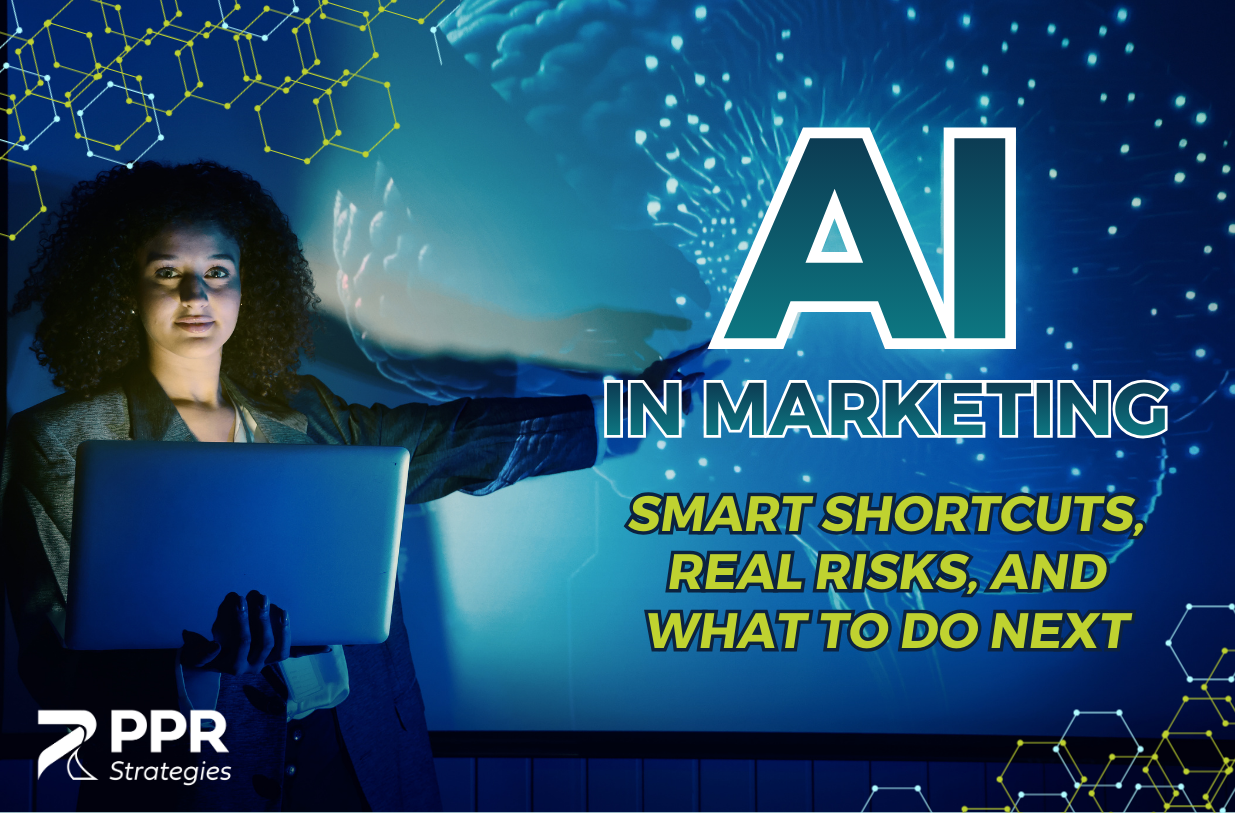
Artificial intelligence (AI) is everywhere right now, and for many teams, it has started to feel like you’re either using it or falling behind.
While AI is useful, it’s not magic. It can help you move faster by brainstorming campaign themes, building outlines, and repurposing content you’ve already created. But it can also introduce inaccuracies, flatten your voice into something generic, and create trust issues if your audience senses you’re cutting corners without guardrails.
At PPR Strategies, we’re all for tools that help teams work smarter. We’re also protective of what makes place-based marketing effective: credibility, context, and human connection. Storytelling only works when the story feels real!
So, if you’re wary of using AI in marketing, you’re not alone. That caution means you care about getting it right. AI can support your voice, but it can’t replace it. Here’s a practical approach with a few guidelines that will keep your content sharp, authentic, and aligned.
AI can be a great drafting partner. It can turn bullet points into paragraphs, adjust variations for different audiences, and help you get unstuck faster than starting from a blank page. What it should not be is your source of truth. AI tools can sound confident while still being wrong!
Always verify outputs from AI tools. That includes program details, funding language, partner quotes, timelines, and performance results. The strongest AI-enabled marketing still has a human editor. Not because you need to “catch typos,” but because you need someone to protect accuracy, voice, clarity, and audience trust. That quick middle step (human editing!) is where most teams win or lose.
Most “AI disappointment” comes from vague prompts. If you give the tool a one-line request, you’ll usually get generic content back. Instead, treat prompting like briefing a teammate. Include:
- Who your target audience is
- What you want the audience to do
- What information should be included (and what shouldn’t)
- What your voice should sound like
If you use OpenAI’s ChatGPT (the paid version), you can create a brand-specific chatbot by uploading instructions and relevant documents, such as editorial style guides, brand guidelines, and writing samples.
You can also save prompts in shared documents, so your team has a go-to toolkit for each AI tool. This helps avoid retyping the same prompt every time, ensures everyone gets the most out of AI, and keeps the team familiar with one to three key tools without reinventing the wheel.
But here’s the non-negotiable: never feed confidential information into AI. These tools can use inputs to train future models, so protect your clients, your community, and your organization by keeping sensitive data private.
One of the smartest, safest ways to use AI is repurposing grounded content—work you’ve already created, vetted, and can confidently stand behind. A strong strategic plan summary can become a blog post, a newsletter blurb, and a short LinkedIn series that highlights key takeaways for different audiences. The same goes for meeting notes and event recaps; these can be shaped into FAQs, talking points, captions, and even quick “what to know” posts for stakeholders. This approach is efficient, but more importantly, it keeps your marketing anchored in what’s real and mitigates the possibility of AI “filling in the gaps” with false information.
If written content is where AI can save you time, imagery is where AI can cost you trust. Visuals carry weight, especially in place-based marketing, because people assume a photo reflects a real moment, a real project, or real community life. When AI-generated images or videos are used casually, they can create instant doubt. Even with good intentions, the result can feel misleading (and unrealistic). There’s also an ethical layer to consider, including questions about how these tools are trained and whether creators’ work was used with appropriate permission.
Learn more about the ethics of AI here!
At the end of the day, AI can support the work, but it can’t replace the thinking behind it. The most powerful marketing is spearheaded by authentic, engaged humans who lead with strategy, context, and a steady hand guiding the message (Yes, we’re taking a bow here.)
Whether you need a marketing team to carry the load or a strategic partner to sharpen your voice, PPR Strategies brings creativity and perspective to help communities and organizations show up clearly and confidently.
Let’s strengthen your marketing in 2026. Drop me a line to share your AI adventures or pitfalls!