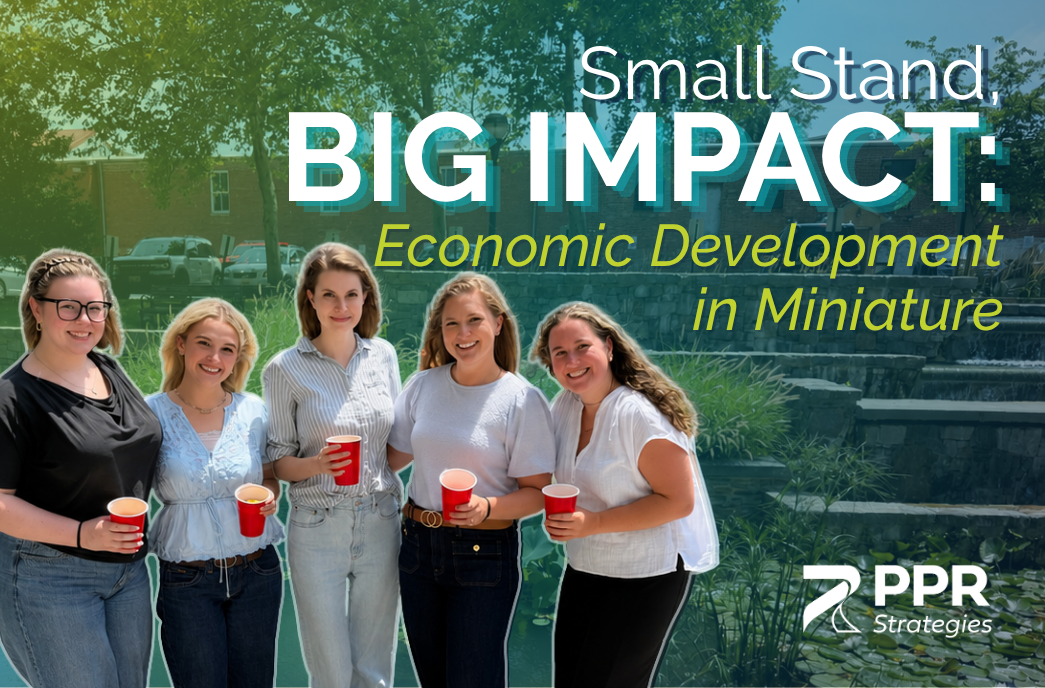
The other day, I stepped outside PPR Strategies’s headquarters in Frederick and into Carroll Creek Linear Park in search of lunch. The afternoon was hot, and you could see the heat waves rising above the brick walkway. As I was walking, I heard:
“Lemonade!”
“Lemonade!”
Under a shady patch of trees, two young girls had set up a small table. A menu was affixed to a nearby lamppost, advertising four flavors in bright, bubbly handwriting. I ordered a strawberry açai lemonade and watched as they carefully measured, mixed, and muddled each ingredient for my cup.
This was not powdered lemonade poured from a plastic pitcher. It was a made-to-order operation.
As they worked, the girls explained that they were raising money to help cover the cost of cheerleading competitions that fall.
“We plan to split the earnings 50/50,” one told me proudly.
I smiled, remembering what it felt like to be in their shoes. Different state, different sport, same early lesson in raising capital: before you can pursue an ambition, you often have to convince someone else to invest in it.
A few minutes later, I returned with no fewer than five coworkers—and I hope you can hear the pride in my voice—who also bought lemonade. Watching another round of cups being carefully prepared, it occurred to me that we were witnessing economic development in miniature.
There was entrepreneurship. Product differentiation. Local spending. Cause-based messaging. Word-of-mouth marketing. A clear division of proceeds. And, perhaps most importantly, a community willing to participate in someone else’s dream.
We tend to picture entrepreneurship beginning with a business plan, a loan application, a storefront lease, or perhaps a pitch delivered across a table of investors. In reality, it often begins much earlier: with a handwritten sign, a borrowed table, and the uncertain hope that someone will stop.
For the seller, that first transaction represents more than a few dollars. It is an early test of whether effort can produce opportunity. It teaches a person to explain an idea, respond to customers, adjust a product, manage money, and tolerate the possibility that people may simply walk past.
The customer teaches something, too.
By stopping, buying, returning, or telling someone else, a customer signals that initiative is worth noticing. That signal may be small, but repeated across a community, it becomes part of a local economic culture.
Communities do not become entrepreneurial through programming alone. Grants, incubators, technical assistance, financing programs, and business counseling all matter. But they work best in places where residents have already developed the habit of noticing local enterprise, talking about it, and rewarding it.
Economic developers often describe this collection of behaviors as “supporting small business.” Yet the phrase can undersell what is actually taking place.
Awareness, neighborliness, trust, visibility, and local pride are not “soft extras” operating at the margins of an economy. They help determine whether a business is discovered, recommended, revisited, and given enough time to grow.
A strong entrepreneurial ecosystem, therefore, depends on more than the supply of entrepreneurs. It also depends on the presence of engaged customers.
That is why shop-local campaigns, business directories, gift card programs, maker districts, and entrepreneur spotlights matter. At their best, they do more than promote individual businesses. They reduce the distance between local producers and potential customers. They make entrepreneurship visible.
Across Maryland, communities are putting that idea into practice.
In Frostburg, the Burg Bucks community gift card program directs spending toward participating businesses while giving residents a simple way to keep more of their purchasing power within the local economy. PPR Strategies supported the program through advertising and outreach designed to generate interest and attract buyers.
With the launch of its new website, Charles County Economic Development Department put forth a local farm directory that brings farmers, farm stores and stands, farm-to-table experiences, seafood businesses, equine operations, and other agricultural destinations together in one central resource.
Allegany County regularly profiles both emerging and established businesses across its evolving commercial landscape. These stories introduce the people behind the storefronts and help residents see local businesses not as interchangeable establishments, but as investments made by neighbors in the future of the community.
Crafted in Bowie takes the concept a step further. The MEDA award-winning initiative is working to transform historic Old Town Bowie into a maker district where microentrepreneurs, artists, and growing businesses can produce, sell, collaborate, and gain visibility.
Queen Anne’s County has similarly invested in telling the stories of its “business ambassadors.” Recognizing that retention can support attraction, the county elevated hallmark businesses through advertorials, web content, and networking opportunities. The effort gave established businesses greater visibility while demonstrating to other employers what it can look like to grow and succeed in the county.
These initiatives vary in size and structure, but each addresses the same fundamental challenge: local businesses cannot benefit from community support if the community does not know they exist.
The work of economic development is often measured through jobs created, capital invested, square footage occupied, or businesses retained. Those measures are essential. But they are downstream from something harder to quantify: the accumulation of thousands of individual decisions to stop, enter, recommend, return, and spend.
No single cup of lemonade changes a local economy. No single social media post, business profile, directory listing, or gift card purchase does either.
But economies are built through repetition.
A recommendation brings five coworkers to a lemonade stand. A profile introduces residents to a business they have passed but never entered. A directory turns a vague desire to buy local into a specific Saturday itinerary. A maker district gives a home-based entrepreneur a place to be seen. One purchase creates the possibility of another.
Economic developers cannot manufacture community loyalty on command. They can, however, create more opportunities for that loyalty to take shape. They can make local businesses easier to find. They can tell stories that turn unfamiliar companies into familiar neighbors. They can build programs that make local purchasing convenient rather than aspirational.
And they can remind people that spending is not merely a private transaction. It is also a vote for the kind of community they want to inhabit.
How will you support “local” this summer? Will you mention the new shop that opened downtown on social media? Will you visit farm stands or enroll in a CSA program? Will you enroll in the community gift card program? Tell me your plans to support economic development efforts, mighty and small!